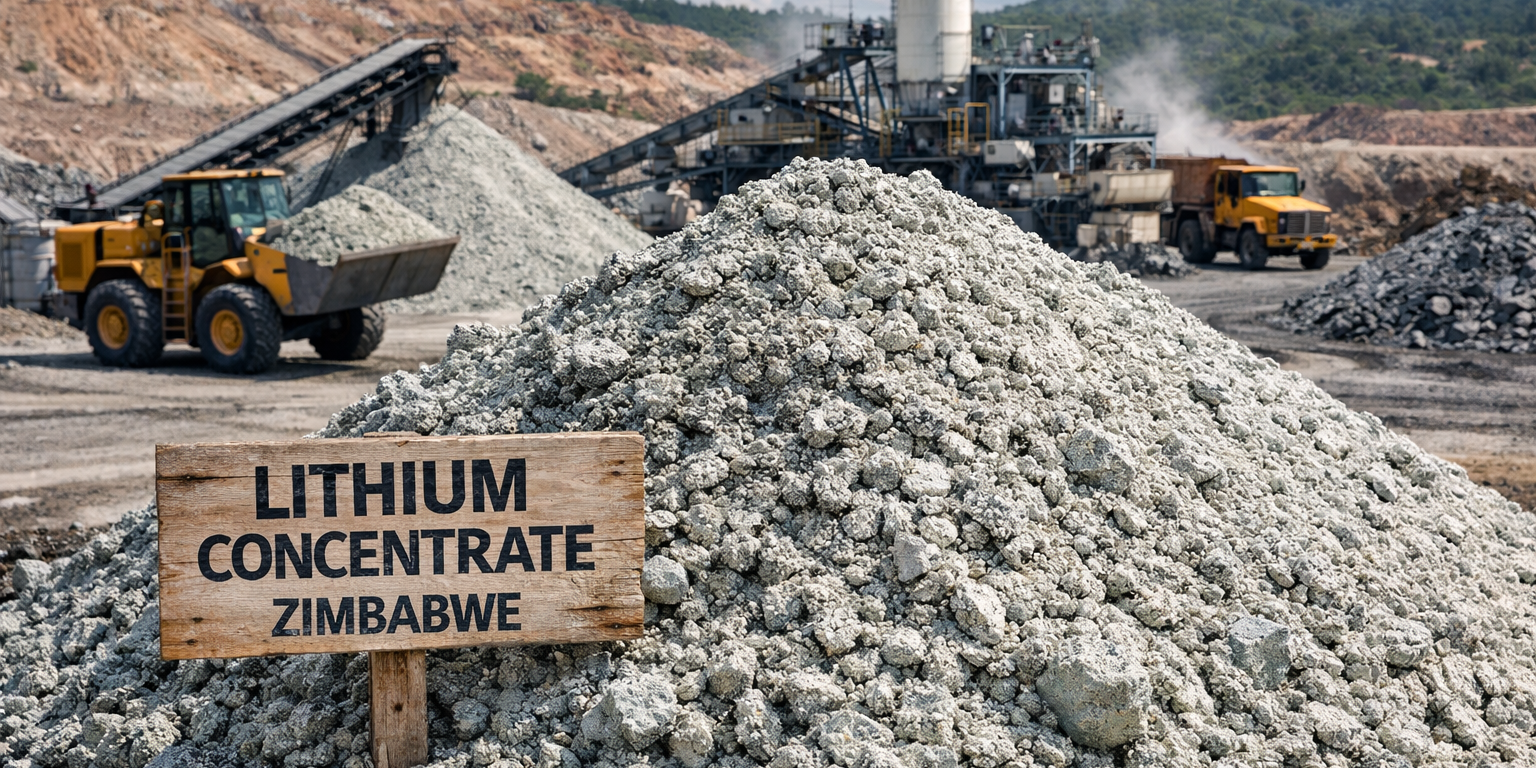
Zimbabwe Lithium Producers Request Delay to 2027 Concentrate Export Ban as Processing Capacity Lags
Lithium miners in Zimbabwe are urging the government to extend deadlines for building local processing facilities ahead of a planned January 2027 ban on lithium concentrate exports, an industry executive said on Thursday.
Zimbabwe, Africa’s largest lithium producer, has been pushing mining companies to increase local beneficiation in order to retain more value from its rapidly growing battery minerals sector.
The government has already introduced lithium concentrate export quotas and imposed a 16% export tax, following a temporary suspension of shipments over concerns about mineral leakage.
According to the Zimbabwe Lithium Producers’ Association, major mining companies are at different stages of developing lithium sulphate processing plants, with only one facility currently operational.
That plant, owned by China’s Zhejiang Huayou Cobalt, is already producing and exporting lithium chemicals.
Other major projects remain under development. Sinomine’s Bikita Minerals and Sichuan Yahua’s Kamativi operations are constructing lithium sulphate plants, while the state-owned Sandawana mine is still conducting feasibility studies on processing capacity.
Speaking at a mining conference in Victoria Falls, association chairperson Innocent Rukweza, who is also CEO of state-owned Mutapa Energy Resources, said the industry has requested additional time to comply with the government’s beneficiation requirements.
“It is a strong appeal that we are presenting to our regulators, that they finalise the ongoing work and consider extending the beneficiation deadline, perhaps to June next year,” Rukweza said.
“We are asking for a bit of flexibility because the current timeline may be too tight.”
The Ministry of Mines and Mining Development did not immediately respond to requests for comment.
Industry facing policy pressure and high costs
Zimbabwe’s lithium sector has been grappling with rising operational costs, heavy taxation, and frequent policy changes, including the temporary export ban introduced earlier this year.
Despite these challenges, Rukweza said the industry remains optimistic, projecting that Zimbabwe could produce up to 344,000 metric tonnes of lithium sulphate annually by 2030, once processing capacity is fully developed.
Chinese companies dominate Zimbabwe’s lithium mining industry, having invested an estimated $2 billion since 2021.
Their involvement has significantly strengthened China’s position in global battery mineral supply chains.
In 2025, Zimbabwe exported approximately 1.13 million tonnes of spodumene concentrate to China, accounting for roughly 15% of China’s total lithium concentrate imports for the year.
Push for local beneficiation
The government’s push for domestic processing is aimed at increasing value addition within Zimbabwe rather than exporting raw or semi-processed materials.
However, industry players say the rapid pace of policy implementation risks outpacing infrastructure development.
As the 2027 deadline approaches, negotiations between miners and authorities are expected to continue as both sides attempt to balance industrial development, investment certainty, and national economic objectives.
About the Author